Tight cargo space
Drinks and day-trip food when footprint matters more than week-long storage.

Car setup / powered cooling
Power plan before quart count. A fridge that fits the bay but cannot stay powered through the trip is the wrong buy. Confirm outlet path, cutoff behavior, vent clearance, and lid swing before sizing up.
Best fit
Drinks and day-trip food when footprint matters more than week-long storage.
More active-cooling storage when the vehicle can lift, power, and vent the larger box.
DC route, fuse limits, cutoff setting, overnight plan. Battery protection is not permission to drain the starter battery.
Spec table
| Decision factor | BougeRV 23 qt CR22 | BougeRV 53 qt E50 |
|---|---|---|
| Capacity | 23 qt (22 L) per BougeRV product page. | 53 qt (50 L) per Amazon listing and BougeRV product page. |
| Power | 12/24V DC and 110 to 240V AC; ECO 36W / MAX 45W per BougeRV. | 12/24V DC and 110 to 240V AC; ECO 45W / MAX 60W per BougeRV. |
| Temperature range | -7°F to 50°F per BougeRV product page. | -4°F to 68°F per BougeRV product page. |
| Battery protection | 3-level vehicle battery cutoff per BougeRV. | 3-level vehicle battery cutoff per BougeRV. |
| Footprint | 22.7 × 12.6 × 13.0 in. exterior per BougeRV; about 21.2 lb. | 25.74 × 13.58 × 20.75 in. exterior per BougeRV; about 45.9 lb. |
| Critical tradeoff | Less internal space; easier to fit beside bags or under a liftgate lip. | More food capacity; needs more cargo room, lifting, and power planning. |
Amazon options
As an Amazon Associate we earn from qualifying purchases.
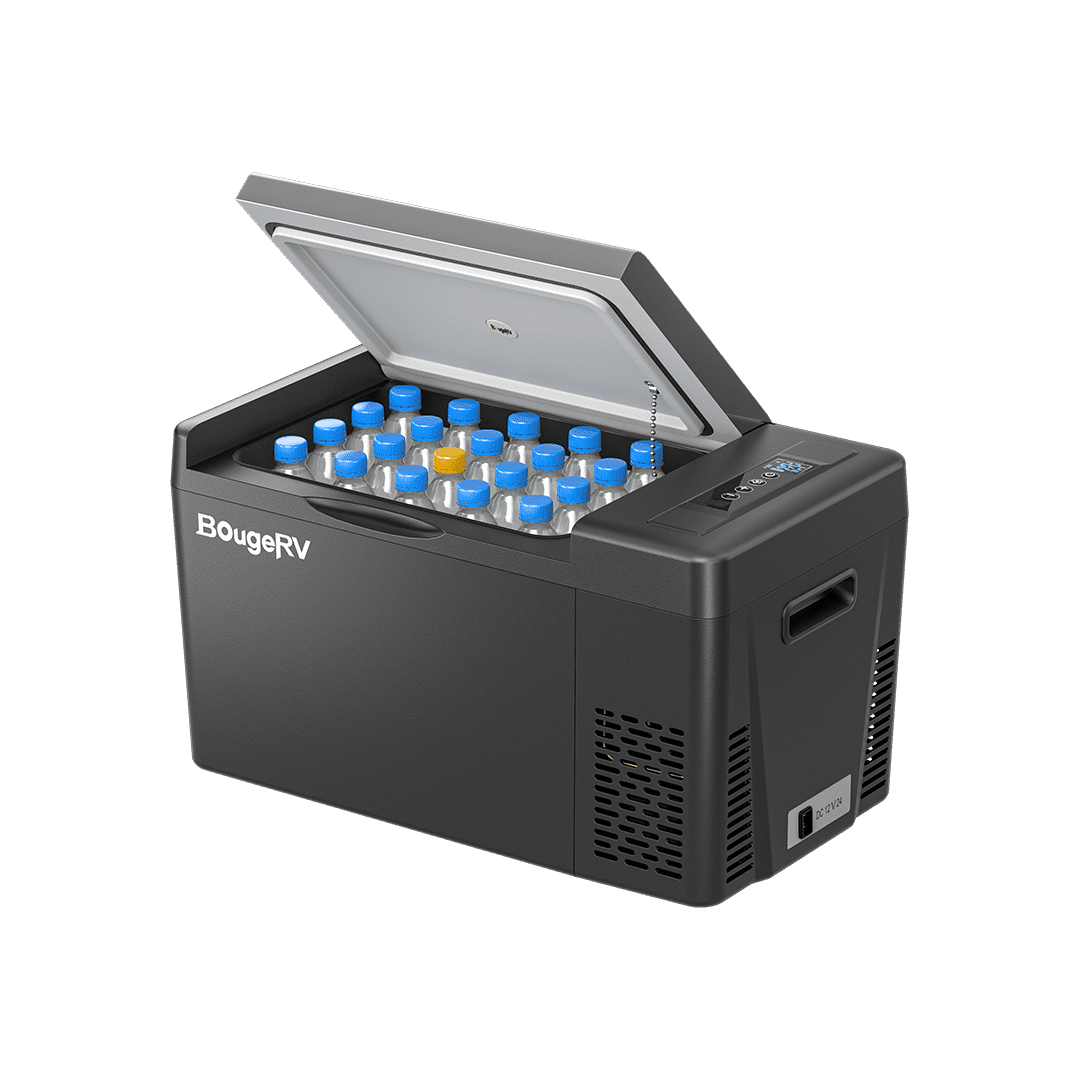
CR22 / ASIN B08G1BBBQW
Compressor, 12/24V DC and 110 to 240V AC, published -7°F to 50°F range, 3-level battery protection. Exterior about 22.7 × 12.6 × 13.0 in., 21.2 lb.
Less internal space than E50. Keep compressor vents clear and secure the unit in transit.
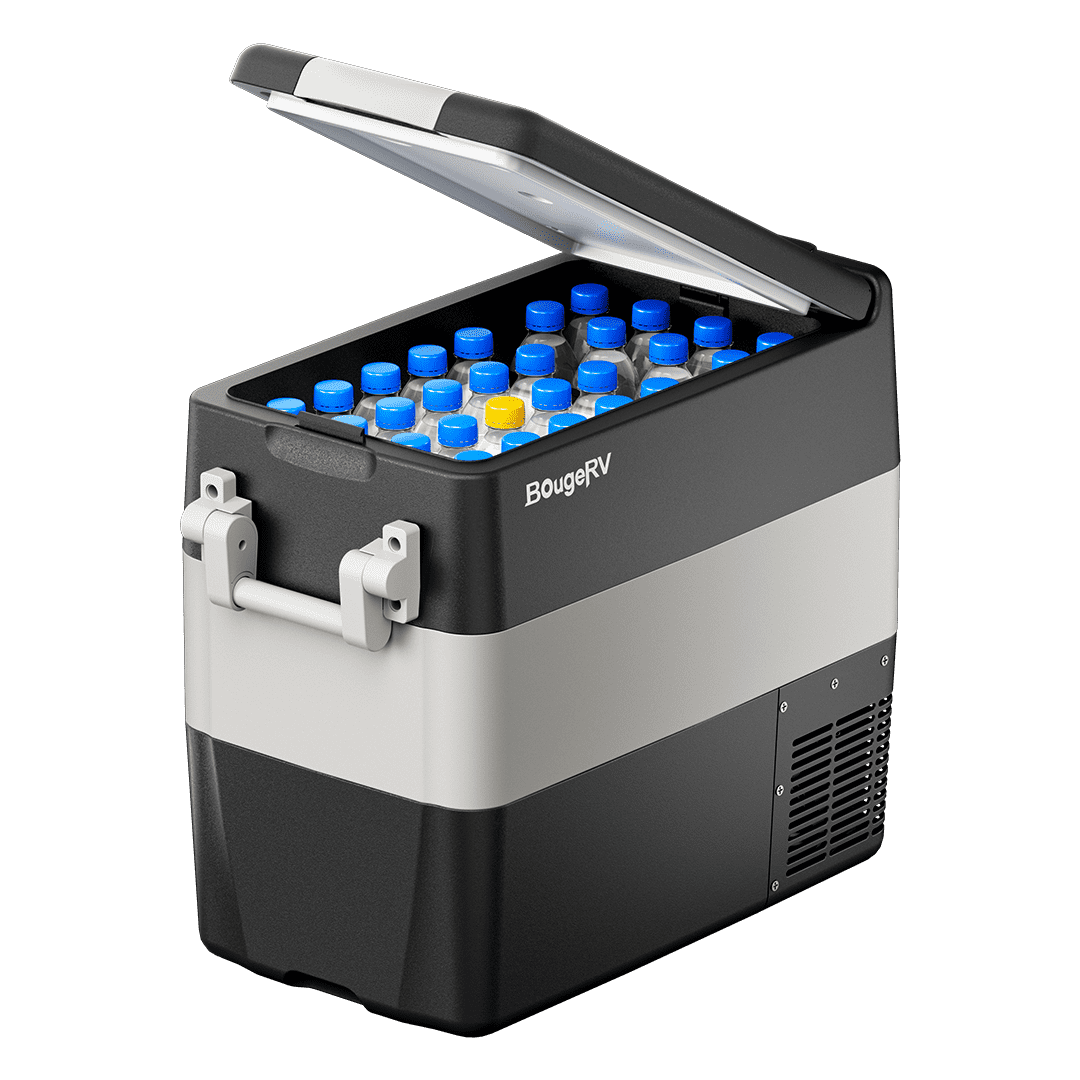
E50 / ASIN B0C4BCD7XQ
Larger load: 53 qt listed, -4°F to 68°F per BougeRV, same DC/AC inputs and 3-level cutoff. About 45.9 lb, 25.74 × 13.58 × 20.75 in. exterior.
Confirm bay, lid path, and power plan before ordering.
Install and reset
Decision checkpoints
Compressor fridges hold set temperature without ice but need continuous power management: outlet, fuse, cutoff, ventilation, overnight plan, cable route.
Passive coolers stay simpler for day trips or vehicles without dependable power. Ice cost may beat electronics complexity.
Pre-chilled food and ice packs for a short drive.
When food must stay cold across repeated stops and power is reliable.
Do not assume starter battery support with engine off. Use cutoff and setup from the manuals.
Fits between bags but cannot open or breathe is the wrong size.
FAQ
Better when active cooling and no ice matter. Cooler is simpler when ice and drainage are easy.
Only with a power source and cutoff plan the vehicle, battery, and fridge support. Do not assume starter battery support with engine off.
Full operating footprint: lid swing, handles, vents, cable, space for passengers or bags.