Parking-lot no-starts
A portable 1,000A jump starter for compatible 12V lead-acid batteries, within the listed engine limits.

Car setup / battery recovery
A jump starter cranks an engine; a charger restores and maintains a battery over time. Choose by the job, outlet access, and battery chemistry.
Which path sounds like your situation?
A portable 1,000A jump starter for compatible 12V lead-acid batteries, within the listed engine limits.
A 5A charger and maintainer for 6V or 12V lead-acid batteries and 12V lithium batteries with a BMS.
Neither device diagnoses a failing battery, charging system, or parasitic draw.
Product options
Buying through our Amazon links costs you nothing extra and helps us keep DadSetup free to read. As an Amazon Associate we earn from qualifying purchases.
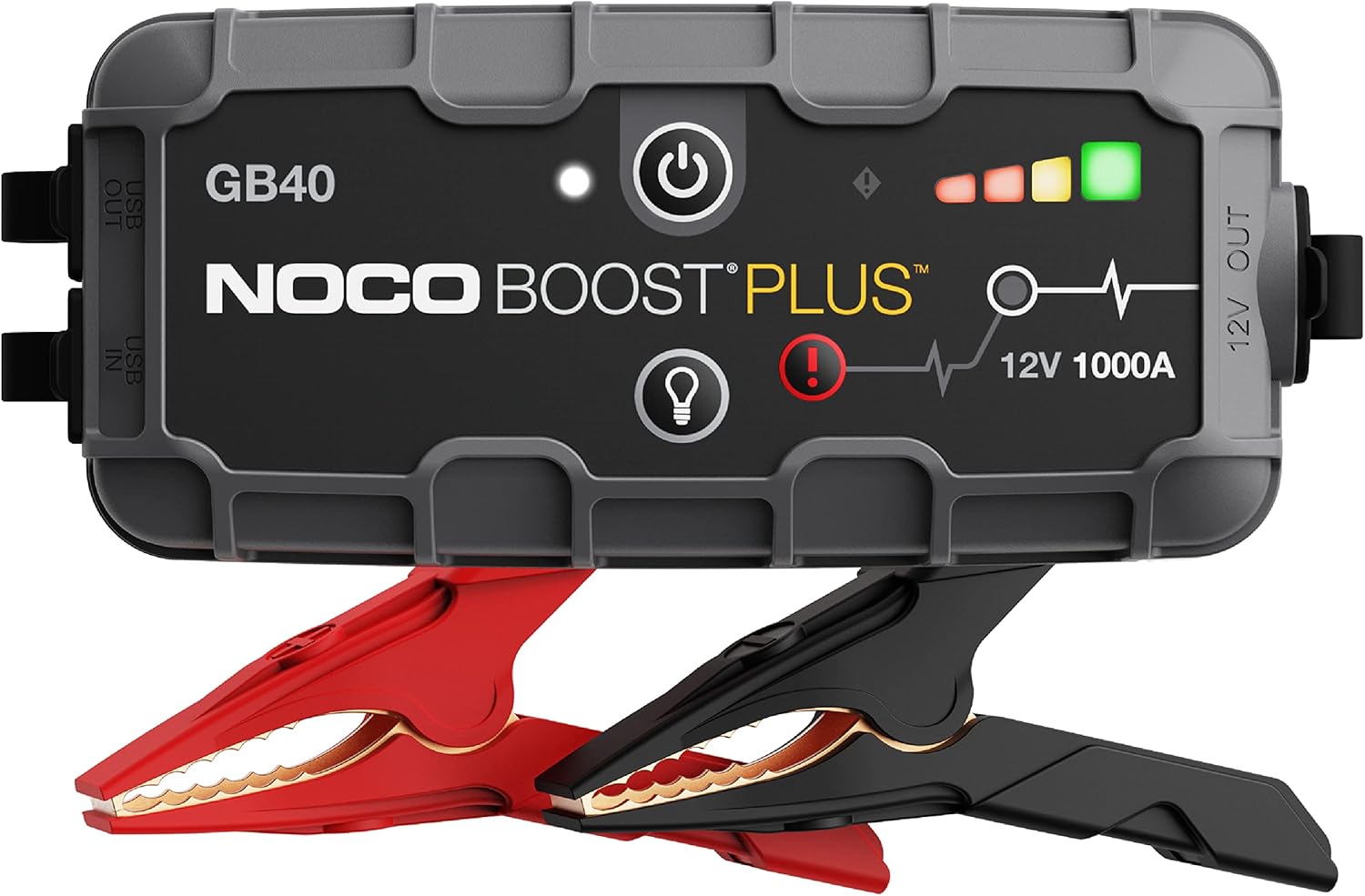
Parking-lot no-starts
Rated at 1,000A peak for gas engines up to 6.0L and diesel engines up to 3.0L. Includes spark-proof clamps, reverse-polarity protection, a 100-lumen light, and USB output.
Tradeoff: It delivers a starting boost, not a charge. Check its battery level and recharge it as the manual directs.

Garage charging and maintenance
5A multi-stage charger with 6V and 12V lead-acid modes, a 12V LiFePO4 mode, temperature compensation, and a selectable 12V Repair mode.
Tradeoff: It needs an AC outlet and cannot provide an immediate engine start.
Head-to-head comparison
| Decision factor | NOCO Boost GB40 | NOCO GENIUS5 |
|---|---|---|
| Primary job | A cordless starting boost away from a wall outlet. | Charging and maintaining a battery near an AC outlet. |
| Power input | Internal lithium battery; recharge by USB. | 120–240V AC household power. |
| Supported batteries | 12V lead-acid only; up to 6.0L gas or 3.0L diesel per NOCO. | 6V and 12V lead-acid; 12V lithium iron phosphate with a battery management system. |
| Low-voltage operation | Detects a 12V battery down to 2V. Manual Override below 2V disables spark-proof and reverse-polarity protection. | Detects batteries from 1V; Force Mode can charge below 1V, down to 0V, with safety features disabled. |
| Charging time | It recharges its own internal pack; it does not charge the vehicle battery. | NOCO estimates about 12 hours for an 80Ah battery at 50% discharge and 18 hours for 120Ah at 50% discharge. |
Why a short drive may not restore a discharged battery
A jump-start may get a vehicle moving, but a short drive does not guarantee that a deeply discharged battery will be fully recharged. Electrical loads, battery condition, state of charge, and the vehicle’s charging system all affect the result.
A lead-acid battery left discharged for an extended period can lose capacity. Use a charger in the correct mode for the battery and investigate repeated drain instead of relying on another boost.
The GENIUS5 time estimates depend on battery size and depth of discharge. NOCO’s chart estimates 12 hours for an 80Ah battery at 50% discharge; a fully or deeply discharged battery can take longer.
When should you skip both?
If the battery case is cracked or swollen, or the vehicle repeatedly fails after an appropriate charge, stop relying on a jump pack and have the battery and charging system checked. Replace the battery when testing confirms it has failed. Check the vehicle manual to see whether a replacement battery needs registration.
FAQ
No. The GB40 is a jump starter that supplies a starting boost; it is not a battery charger. Use a charger matched to the battery chemistry and follow the vehicle and charger manuals.
It depends on capacity, state of charge, condition, temperature, and charging stage. NOCO estimates about 12 hours for an 80Ah battery at 50% discharge; a deeper discharge takes longer.
The manual provides Manual Override for a 12V lead-acid battery below 2V, but that disables spark-proof and reverse-polarity protection. Use only as the manual directs; seek professional help if unsure.
What should I read next?